
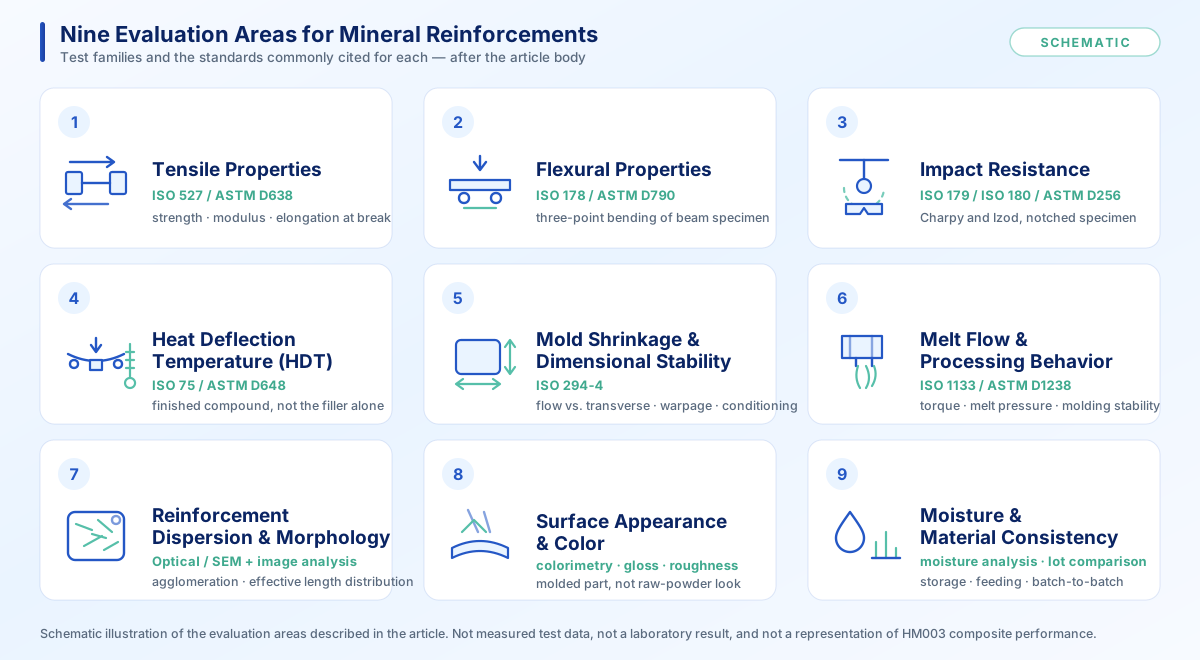
Introduction
引言
Selecting a new reinforcement material for engineering thermoplastics requires more than comparing supplier datasheets.
为工程热塑性塑料选择一种新的增强材料,不仅仅是对比供应商的数据表。
A mineral reinforcement may offer attractive physical characteristics, but its actual value depends on how it performs within a specific polymer formulation and manufacturing process.
矿物增强材料可能具有吸引人的物理特性,但其实际价值取决于它在特定聚合物配方和制造工艺中的表现。
For compounders working with polypropylene (PP), polyamide (PA), polybutylene terephthalate (PBT), or other engineering thermoplastics, a structured testing program helps identify potential benefits, limitations, and processing trade-offs.
对于使用聚丙烯(PP)、聚酰胺(PA)、聚对苯二甲酸丁二醇酯(PBT)或其他工程热塑性塑料的混配厂商,系统化的测试程序有助于识别潜在的收益、局限以及加工方面的权衡。
This guide introduces nine important evaluation areas for mineral-based reinforcements, including calcium sulfate whiskers (CSW).
本指南介绍矿物基增强材料(包括硫酸钙晶须 CSW)的九个重要评估领域。
The objective is not to replace established reinforcement systems, but to help engineers make informed decisions when evaluating additional formulation options.
目的并非取代成熟的增强体系,而是帮助工程师在评估其他配方方案时做出有依据的决策。
1. Tensile Properties
1. 拉伸性能
Typical standards: ISO 527 / ASTM D638
常用标准:ISO 527 / ASTM D638
Tensile testing measures how a material responds to a pulling force.
拉伸测试测量材料对拉伸力的响应。
Key parameters include tensile strength, tensile modulus, and elongation at break.
关键参数包括拉伸强度、拉伸模量和断裂伸长率。
For reinforced polymers, these measurements help determine whether a new reinforcement contributes to stiffness or strength without causing an unacceptable loss of ductility.
对于增强聚合物,这些测量有助于判断一种新的增强材料是否能在不造成不可接受的延展性损失的前提下,提升刚度或强度。
Engineering consideration: Compare specimens produced under equivalent molding and conditioning conditions. Higher tensile modulus does not necessarily mean better overall performance.
工程注意事项:应在等效的成型与调节条件下制备试样再进行对比。更高的拉伸模量并不必然意味着整体性能更优。
2. Flexural Properties
2. 弯曲性能
Typical standards: ISO 178 / ASTM D790
常用标准:ISO 178 / ASTM D790
Flexural testing evaluates a material's response to bending loads.
弯曲测试评估材料对弯曲载荷的响应。
Flexural strength and flexural modulus are particularly relevant to structural housings, brackets, and other components exposed to bending stresses.
弯曲强度和弯曲模量与结构外壳、支架以及其他承受弯曲应力的部件尤为相关。
Whisker morphology may influence the mechanical response of a composite, but the final result depends on dispersion, interfacial adhesion, reinforcement loading, and processing conditions.
晶须形貌可能影响复合材料的力学响应,但最终结果取决于分散状态、界面粘接、增强用量和加工条件。
Engineering consideration: Evaluate flexural properties alongside impact resistance and the requirements of the intended part.
工程注意事项:应结合抗冲击性能以及目标零件的要求一起评估弯曲性能。
3. Impact Resistance
3. 抗冲击性能
Typical standards: ISO 179 / ISO 180 / ASTM D256
常用标准:ISO 179 / ISO 180 / ASTM D256
Impact testing helps assess the ability of a polymer material to resist sudden loading.
冲击测试有助于评估聚合物材料抵抗突然加载的能力。
Common methods include Charpy and Izod testing.
常用方法包括夏比(Charpy)和悬臂梁(Izod)测试。
Introducing a rigid reinforcement may improve certain stiffness-related properties while reducing impact resistance, depending on the formulation.
引入刚性增强材料可能在改善某些刚度相关性能的同时降低抗冲击性能,具体取决于配方。
Engineering consideration: Do not evaluate stiffness improvements in isolation. Compare impact performance against the application-specific acceptance criteria.
工程注意事项:不要孤立地评估刚度的提升。应将冲击性能与应用特定的验收标准进行对比。
4. Heat Deflection Temperature (HDT)
4. 热变形温度(HDT)
Typical standards: ISO 75 / ASTM D648
常用标准:ISO 75 / ASTM D648
Heat deflection temperature indicates how a polymer specimen behaves under a specified load as temperature increases.
热变形温度表示聚合物试样在温度升高时、于规定载荷下的表现。
It is an important consideration for applications involving elevated temperatures and mechanical stresses.
对于涉及较高温度和机械应力的应用,这是一项重要的考量。
The thermal resistance of an inorganic reinforcement must not be confused with the heat deflection temperature of the finished polymer composite. For example, the reported thermal resistance of Hancore HM003 calcium sulfate whisker material is up to 1000°C. This does not mean a polymer compound containing HM003 can operate at 1000°C.
无机增强材料自身的耐热性,不得与最终聚合物复合材料的热变形温度混为一谈。例如,Hancore HM003 硫酸钙晶须材料所报告的耐热性最高可达 1000°C,但这并不意味着含有 HM003 的聚合物配方可以在 1000°C 下工作。
Engineering consideration: Evaluate HDT using the finished compound under the relevant test conditions.
工程注意事项:应在相关测试条件下,使用最终配方料来评估 HDT。
5. Mold Shrinkage and Dimensional Stability
5. 成型收缩与尺寸稳定性
Relevant method: ISO 294-4 for applicable injection-molded thermoplastic specimens
相关方法:ISO 294-4(适用于相应的注塑热塑性塑料试样)
Molding shrinkage and dimensional stability are critical considerations in precision plastic components.
成型收缩与尺寸稳定性是精密塑料件的关键考量。
Reinforcement morphology, orientation, loading, and polymer crystallization behavior can influence dimensional changes.
增强材料的形貌、取向、用量以及聚合物的结晶行为都会影响尺寸变化。
For injection-molded components, engineers should consider shrinkage in different directions, warpage, and dimensional consistency after conditioning.
对于注塑件,工程师应考虑不同方向上的收缩、翘曲,以及调节后的尺寸一致性。
Engineering consideration: Laboratory specimen results should be supplemented by evaluations using representative molded parts where necessary.
工程注意事项:必要时,实验室试样的结果应辅以使用代表性制件的评估。
6. Melt Flow and Processing Behavior
6. 熔体流动与加工行为
Typical standards: ISO 1133 / ASTM D1238 for applicable melt-flow measurements
常用标准:ISO 1133 / ASTM D1238(适用于相应的熔体流动测量)
Reinforcement materials can affect the flow characteristics of a polymer compound.
增强材料会影响聚合物配料的流动特性。
Melt mass-flow rate or melt volume-flow rate measurements may provide useful screening information, but they do not fully describe processing behavior in an extruder or injection-molding machine.
熔体质量流动速率或熔体体积流动速率测量可提供有用的筛选信息,但不能完整描述挤出机或注塑机中的加工行为。
Important processing observations may include extrusion torque, melt pressure, feeding consistency, dispersion, and molding stability.
重要的加工观测项目可包括挤出扭矩、熔体压力、加料稳定性、分散状态和成型稳定性。
Engineering consideration: Evaluate processing performance under representative manufacturing conditions, especially when introducing high-aspect-ratio reinforcement materials.
工程注意事项:应在具有代表性的生产条件下评估加工性能,尤其在引入高长径比的增强材料时。
7. Reinforcement Dispersion and Morphology
7. 增强材料分散与形貌
Typical methods: Optical microscopy, scanning electron microscopy, and suitable image analysis
常用方法:光学显微镜、扫描电子显微镜以及合适的图像分析
Dispersion is particularly important when evaluating fine inorganic fibers or whisker-type materials.
在评估细无机纤维或晶须类材料时,分散状态尤为重要。
Agglomeration may cause inconsistent mechanical properties, local defects, and poor surface appearance.
团聚可能导致力学性能不一致、局部缺陷以及表面外观不良。
For calcium sulfate whiskers, microscopy can help examine morphology and investigate whether processing changes the effective whisker length distribution.
对于硫酸钙晶须,显微技术可用于观察形貌,并考察加工是否会改变晶须的有效长度分布。
Engineering consideration: Establish a consistent sample preparation and imaging procedure before comparing different formulations.
工程注意事项:在比较不同配方之前,应建立一致的制样与成像流程。
Microscopy provides useful structural information, but images alone do not establish composite mechanical performance.
显微技术可提供有用的结构信息,但仅凭图像本身不能确立复合材料的力学性能。
8. Surface Appearance and Color
8. 表面外观与颜色
Possible methods: Visual inspection, colorimetry, gloss measurement, and surface roughness testing
可用方法:目视检查、色度测量、光泽度测量以及表面粗糙度测试
Appearance is an important engineering requirement for many molded components.
对于许多模塑件,外观是一项重要的工程要求。
Reinforcement materials can influence surface finish, color uniformity, and the visibility of defects.
增强材料会影响表面光洁度、颜色均匀性以及缺陷的可见程度。
Calcium sulfate whiskers are typically supplied as white powders, which may be of interest when developing formulations with appearance requirements.
硫酸钙晶须通常以白色粉末形式供货,这在开发对外观有要求的配方时可能具有价值。
However, the appearance of the finished molded part depends on the complete formulation and processing conditions.
然而,最终制件的外观取决于完整配方和加工条件。
Engineering consideration: Use representative molded samples and agreed acceptance criteria rather than relying only on raw-material appearance.
工程注意事项:应使用具有代表性的制样和双方认可的验收标准,而不是仅依赖原材料的外观。
9. Moisture and Material Consistency
9. 水分与材料一致性
Possible methods: Application-appropriate moisture analysis, incoming inspection, and batch-to-batch comparison
可用方法:适用于具体应用的含水量分析、进料检验以及批次间比对
Moisture and raw-material consistency can influence handling, processing, and finished-part performance.
水分与原材料一致性会影响搬运、加工以及最终制件的性能。
For hygroscopic polymers such as polyamides, moisture conditioning and drying procedures are especially important.
对于聚酰胺等吸湿性聚合物,水分调节与干燥程序尤为重要。
When evaluating a new mineral reinforcement, engineers should consider the reinforcement's moisture specification, storage conditions, feeding behavior, and consistency between production lots.
在评估一种新的矿物增强材料时,工程师应考虑其水分指标、储存条件、加料行为以及不同生产批次之间的一致性。
Engineering consideration: Establish incoming-material requirements and confirm that test specimens have been prepared under comparable conditions.
工程注意事项:应建立进料要求,并确认测试试样是在可比的条件下制备的。
Building a Practical Evaluation Program
构建实用的评估程序
A useful evaluation program begins with clearly defined performance objectives.
有效的评估程序始于明确定义的性能目标。
Rather than testing every possible property, engineers should prioritize the characteristics that matter most for their application.
工程师应优先关注对其应用最重要的特性,而不是测试所有可能的性能。
A practical sequence may include:
一个实用的顺序可以包括:
- Establishing a baseline formulation using the existing reinforcement system.
- 使用现有增强体系建立基准配方。
- Selecting initial loading levels for the candidate reinforcement.
- 为候选增强材料选定初始添加量。
- Preparing compounds using controlled processing conditions.
- 在受控的加工条件下制备配料。
- Evaluating dispersion and process stability.
- 评估分散状态与工艺稳定性。
- Measuring mechanical, thermal, and dimensional properties.
- 测量力学、热学与尺寸性能。
- Comparing results against the baseline and application requirements.
- 将结果与基准及应用要求进行对比。
- Identifying promising formulations for further validation.
- 筛选出有前景的配方以进行进一步验证。
Where appropriate, engineers may also investigate hybrid reinforcement systems, surface-treatment options, and alternative processing configurations.
在适当情况下,工程师还可研究混杂增强体系、表面处理方案以及替代的加工配置。
Where Calcium Sulfate Whiskers Fit into the Evaluation
硫酸钙晶须在评估中的定位
Calcium sulfate whiskers are elongated inorganic crystalline fibers with potential relevance to polymer reinforcement research.
硫酸钙晶须是细长的无机结晶纤维,与聚合物增强研究具有潜在的相关性。
Their acicular morphology distinguishes them from conventional particulate mineral fillers.
其针状形貌使其区别于常规的颗粒状矿物填料。
Hancore's HM003 standard grade has selected producer specifications including:
Hancore HM003 标准等级具有若干生产商规格,包括:
| Property | 项目 | HM003 | HM003 |
|---|---|---|---|
| CaSO4 purity | CaSO4 纯度 | ≥98% | ≥98% |
| Whisker aspect ratio | 晶须长径比 | 40–80 | 40–80 |
| Whisker length | 晶须长度 | 10–300 μm | 10–300 μm |
| Whisker diameter | 晶须直径 | 1–4 μm | 1–4 μm |
| Whiteness | 白度 | 95% | 95% |
| Material thermal resistance | 材料本体耐热性 | Up to 1000°C | 最高 1000°C |
These are material-level producer specifications, not demonstrated performance results for a particular polymer compound.
这些是材料层面的生产商规格,并非某一特定聚合物配方已被证实的性能结果。
For compounders interested in CSW, the most useful next step is to identify a specific formulation objective and design a comparative evaluation.
对于关注 CSW 的混配厂商,最有价值的下一步是明确具体的配方目标,并设计对比评估。
Conclusion
结论
The successful qualification of a new mineral reinforcement depends on a combination of material characteristics, processing behavior, and application-specific performance.
一种新的矿物增强材料能否成功通过认证,取决于材料特性、加工行为与应用特定性能的综合表现。
A structured evaluation approach helps engineers distinguish promising formulation opportunities from improvements that may not translate into practical manufacturing benefits.
结构化的评估方法有助于工程师区分有前景的配方机会,与那些可能无法转化为实际制造收益的改进。
Calcium sulfate whiskers represent an additional inorganic microfiber reinforcement option worth investigating where their morphology and material characteristics align with formulation objectives.
硫酸钙晶须代表了一种额外的无机微纤维增强选项,在其形貌与材料特性与配方目标相符时值得深入研究。
Explore HM003 with Hancore
与 Hancore 一起探索 HM003
Interested in evaluating engineered calcium sulfate whiskers for your next polymer formulation? Contact Hancore New Materials to discuss HM003 technical specifications and potential sample evaluation.
希望在下一次聚合物配方中评估工程化硫酸钙晶须?请联系 Hancore New Materials,讨论 HM003 技术规格与样品评估的可能性。
Hancore New Materials · Xiamen Hangcai Technology Co., Ltd. · sales@hancore-material.com
Hancore New Materials · 厦门市航才科技有限公司 · sales@hancore-material.com
Technical Notes
技术说明
The test standards mentioned in this article are common examples. The appropriate standard, method edition, specimen preparation, and testing conditions must be selected for the relevant polymer, application, and customer specification.
本文中提及的测试标准为常见示例。应根据相关聚合物、应用和客户规格,选择适当的标准、方法版本、试样制备和测试条件。
This article provides general engineering guidance. It does not constitute a certification, application-specific performance guarantee, or published test report for HM003.
本文提供一般性工程指导,不构成针对 HM003 的认证、特定应用性能保证或已发表的测试报告。
The HM003 specifications are producer-provided material data. Independent verification and application-specific composite testing may be arranged as required.
HM003 规格为生产商提供的材料数据。如有需要,可安排第三方验证与针对具体应用的复合材料测试。